






On November 11, a single blue stone with a passport stamped by Fabergé, the Russian Revolution, an opera star and Cartier heads to the auction block at Sotheby's in Geneva. It weighs 197.80 carats. That is nearly 40 grams of sapphire, which is the kind of number that makes everyone at our bench put down their tweezers for a minute.
We will never set the Romanov Sapphire (we checked our calendar, and our tweezers). But a stone like this is a great excuse to talk about why sapphire has been the royal blue for centuries, what the tiny "flaws" inside it are really saying, and how that same deep blue ends up on regular hands in Atlanta, Denver and everywhere our Brown Box travels.
Meet the Romanov Sapphire
According to National Jeweler, the stone is an unheated Ceylon (Sri Lankan) sapphire, originally mounted by Fabergé. Dowager Empress Maria Feodorovna, mother of Nicholas II, wore it at the 1903 Winter Palace Ball, where a photo shows it on her skirt as one of a pair. The second stone is now lost.
After 1917 it was catalogued in the Fersman inventory of Russian regalia, left Russia in the Soviet dispersal sales, passed to opera singer and collector Ganna Walska, and was later acquired by Cartier, which set it in a bracelet in 2015. Sotheby's estimate is CHF 850,000 to 1.7 million (roughly $1 to $2 million), and the auction house calls it "one of the most significant surviving witnesses to the splendor of the Romanov dynasty," as quoted by National Jeweler.
Our favorite detail: the Cartier bracelet is built so the sapphire can be swapped out for an engraved rock crystal. A royal stone with a removable center. Jewelers love a clever mechanism.

Why a Sapphire Outlives an Empire
Sapphire is corundum, the same mineral family as ruby. GIA puts it at 9 on the Mohs hardness scale, second only to diamond among the gems you will see in a jewelry case. That toughness is a big reason a stone can survive a ballroom, a revolution, a few ocean crossings and a century of owners and still look sharp.
At the bench, that hardness changes how we work. A sapphire tolerates the pressure of prongs being pushed over its edges, which is why sapphire is such a natural fit for an engagement ring you wear every single day. Softer stones ask for gentler settings. Sapphire just asks for good prongs and a steady hand.
A great sapphire is not just blue. It is blue that holds up to real life, which is exactly what you want on the hand you wave, cook and hold hands with.
The Beautiful Flaws Inside
Here is a fun bit of timing. The same week the Romanov Sapphire heads to Geneva, GIA announced it acquired 2,665 crystals, gems and minerals collected over 60 years by John Koivula, a GIA analytical microscopist widely considered a leading expert on inclusions. Think a fan of mica frozen inside tourmaline, or fluorescent petroleum trapped in quartz. GIA plans to use the collection for education, research and gem identification, and to show select pieces at the 2027 Tucson shows.
Inclusions are a gem's fingerprints. In sapphire, GIA notes the stone "often contains delicate intersecting needles of rutile that gemologists call silk." For a natural, unheated stone like the Romanov, those tiny features help specialists read where it formed and whether it has been treated. They are part of its story, not a mistake.
For us, every stone goes under the loupe before it is set. With the lab-grown blue sapphires we use in pieces like our Diana-style rings and sapphire eternity bands, we are looking for color first: a saturated royal blue that does not go inky in low light or washed-out in daylight.
Royal Blue, Without the Royal Treasury
You do not need an imperial inventory number to wear this color. A few of our pieces that carry the same mood:
- The Diana Royale: a deep blue sapphire in a full diamond halo, the most "ballroom" of our sapphire rings.
- The Modified Diana: a 6×8mm oval lab-grown blue sapphire with pear-shaped diamonds at the shoulders for a longer, more modern line.
- Oval Blue Sapphire Eternity Band: 5.04 total carats of oval lab-grown sapphires all the way around. Royal blue from every angle, no ball gown required.
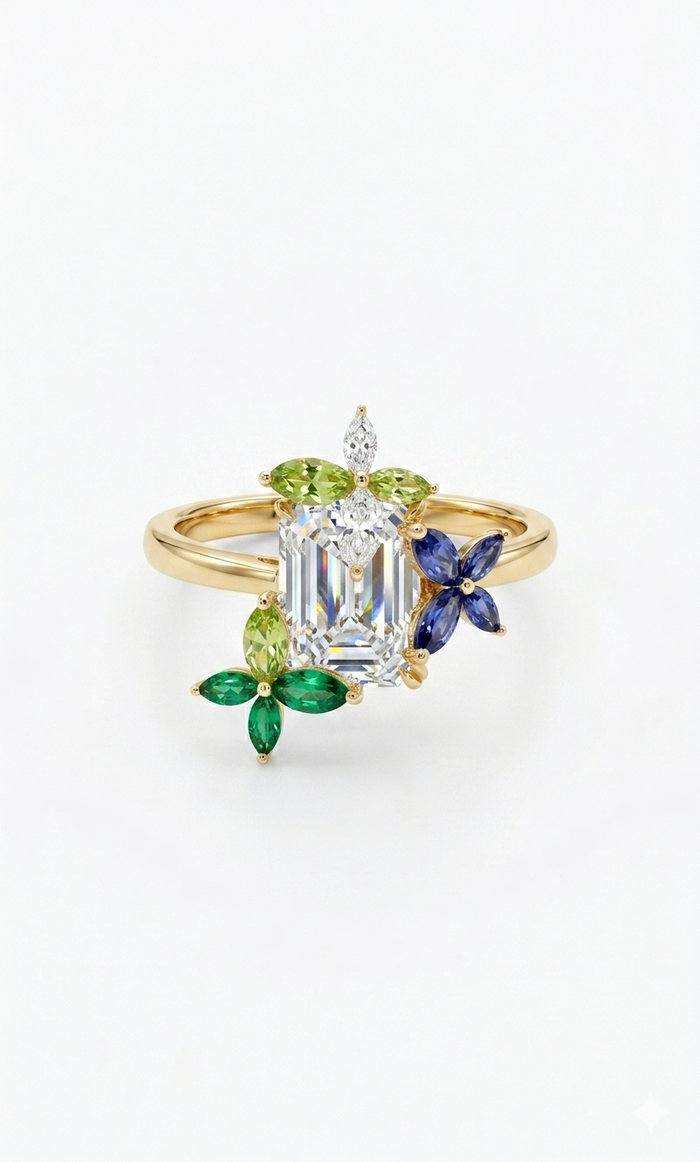
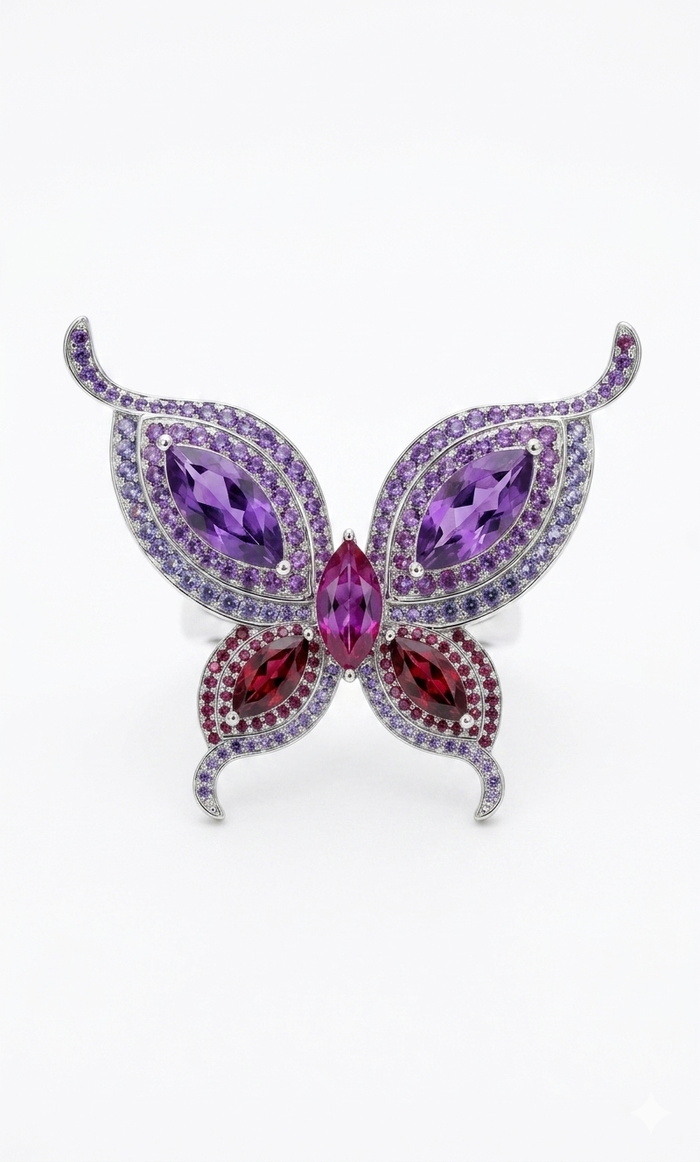
- The Jardin in Sky Blue: if royal blue feels a little formal, Mr. Lee's butterfly setting, inspired by our family's garden in Korea, frames a lighter, icy sapphire instead.
One more lot in the same Geneva sale caught our eye: a toi et moi ring pairing a Kashmir sapphire with a Colombian emerald. Two stones, side by side, "you and me." If that format makes your heart skip, our Elysia pairs a color-changing alexandrite with a pear diamond in the same spirit.

Cheat Sheet: Read a Sapphire Like an Auction Specialist
- Color first. Look at it in daylight and under a warm lamp. Great blue stays blue in both.
- Origin words can mean two things. At auction, "Ceylon" or "Kashmir" names where a natural stone came from. When you see a color name on a lab-grown stone, it describes a look, not a mine.
- Treatment matters. "Unheated" is a big deal for natural stones and a big part of why the Romanov's estimate looks the way it does.
- Silk is a clue, not a flaw. Fine needles of rutile are one of sapphire's classic fingerprints.
- Setting is half the story. Fabergé, then Cartier. The mount changes how a stone reads, and that is where our bench lives.
September babies, take note: sapphire is your birthstone. If you love the idea of carrying a little royal blue in secret, our complimentary Stone Inlay® sets a hidden birthstone inside the band, just for the wearer.
Your Own Heirloom Starts Smaller (and Closer)
The Romanov Sapphire took a Fabergé mount, an empress, a revolution and a Cartier bracelet to become what it is. Your sapphire only needs a good idea and a family studio that loves building them. Every piece we make is handcrafted from scratch, backed by a lifetime warranty, and ships free worldwide in the Luther's Brown Box.
Have a sapphire ring in your head that does not exist yet? Tell us about it here, or browse our sapphire jewelry to start dreaming in blue.
Further reading
- National Jeweler: 197-Carat "Romanov Sapphire" Heads to Sotheby's Geneva (Nov. 2, 2026)
- ITV News: Russian crown jewel from Romanov dynasty could fetch £1.5m at auction (Oct. 29, 2026)
- National Jeweler: GIA Acquires Thousands of Gem Specimens With "Extraordinary" Inclusions (Nov. 9, 2026)
- GIA: Sapphire description